

AI Adoption Barriers and the Future of Autonomous Print Workflows
AI is no longer as fantastical as it once was. Tools like ChatGPT and Claude are no longer considered futuristic ideas or exclusive to tech firms.
AI is quickly integrating into the fundamental operational framework of many different business sectors. Although acceptance in the print industry has been slower than in other industries, there is no denying that autonomous print operations are on the horizon.
The Reality of AI Adoption Challenges in Print
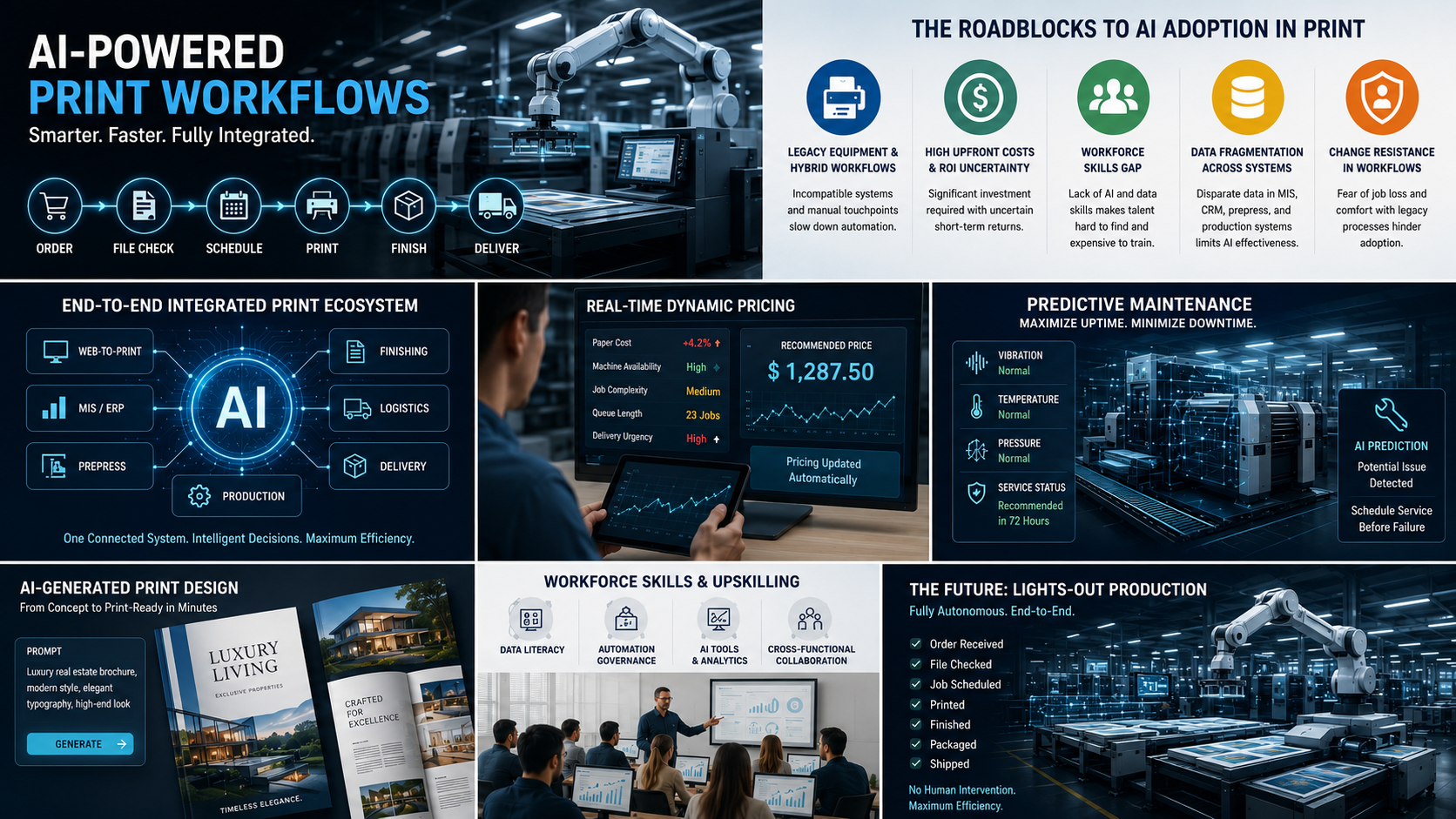
Despite recent advancements in prepress, workflow management and production optimisation, many print companies have found it difficult to effectively incorporate AI solutions into their current workflows. The challenges of incorporating AI into current production environments with deeply established processes are more important than the technology.
The secret is to take a phased approach: map data flows, establish precise success indicators and begin with pilot projects. Make sure governance, security and compliance are integrated from the start by investing in staff training and compatibility between new AI tools and existing systems. This opens the door to modest, scalable improvements.
Legacy Equipment and Hybrid Workflows
A majority of print companies use a combination of modern digital equipment and older offset presses, which are typically bought over time and in response to urgent business requirements. For these hybrid workflows to function well, human intervention is frequently necessary.
Platforms for automation or artificial intelligence are typically not backward-compatible, which means they don’t function well with earlier technologies or platforms. Furthermore, it is challenging to replace these current models because they are typically not cheap.
High Upfront Costs and ROI Uncertainty
In order to adopt AI, companies also need to invest in new software and cloud tools, as well as upgrade their MIS (Management Information Systems).
The significant setup expenditure requirement is a barrier despite the long-term cost savings that these enhancements offer. Small and medium-sized print shops and other print enterprises with narrow profit margins are especially vulnerable to this issue.
Workforce Skills Gap
A print employee’s profile has changed. The typical production crew rarely works with software, instead concentrating mostly on mechanical and operational tasks.
However, the sector will need an entirely new set of capabilities once AI operations are introduced. For instance, simple data literacy is not enough to manage automation platforms.
Many companies lack employees who are qualified for these positions. Additionally, they lack the funds to invest in this kind of training and even if they had, they are frequently hard to come by. A trend towards upskilling initiatives, cross-training, and collaborations with academic institutions will be prompted by this skills deficit. To remain competitive, businesses need to establish clear competency maps, make investments in useful sandbox settings, and foster a culture of ongoing learning. It will be crucial to prioritise data literacy, automation governance and departmental cooperation.
System-Level Fragmentation of Data
AI has limitations despite its power. The best place to start is with clean, cohesive data that functions under one roof. Things are a little trickier when it comes to legacy systems. Data is frequently dispersed throughout multiple systems, such as MIS, CRM, prepress, production software and so forth.
When fragmentation occurs without integration, fragmentation results. In addition to being ineffective, system communication is not automatic. Manual input and intervention frequently limit the performance advantage from AI integration.
Change Resistance in Workflows
Ultimately, the obstacle we encounter is not related to technology but rather to human nature. In many respects, the print business is conservative and employees are frequently hesitant to let AI automatically adjust prices, scheduling and even output.
Furthermore, there are still a lot of concerns about AI. Employee reluctance to change in legacy systems is exacerbated by worries about job losses brought on by the incorporation of AI operations.
Autonomous Print Ecosystems: The Future Direction
AI will undoubtedly play an increasingly significant part in print workflows, notwithstanding the difficulties the print sector has in integrating AI.
“Lights-Out” Production that is Fully Autonomous
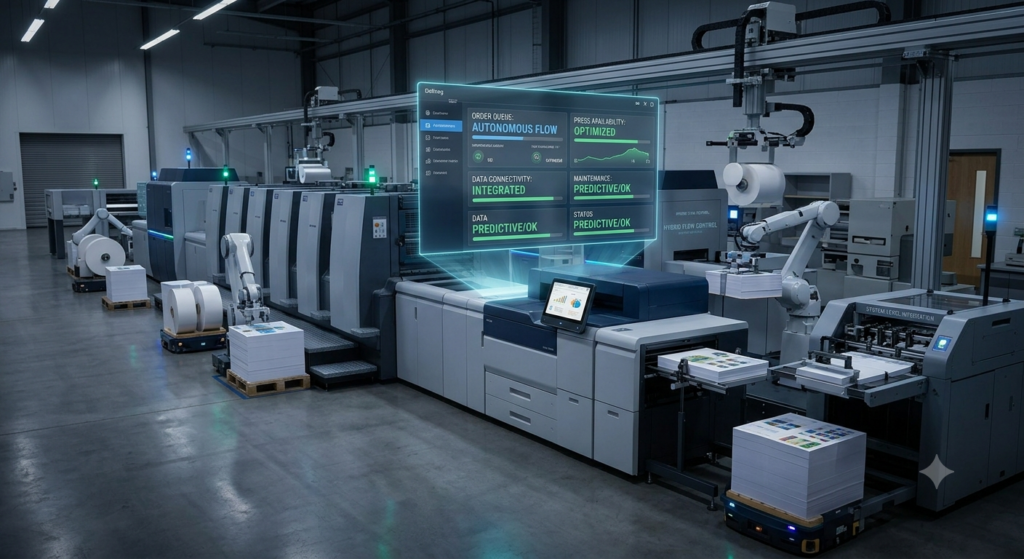
Let’s start with the most revolutionary idea: “lights out” production. This process is fully automated. Print jobs require extremely little human intervention, in contrast to the active administration of routine processes.
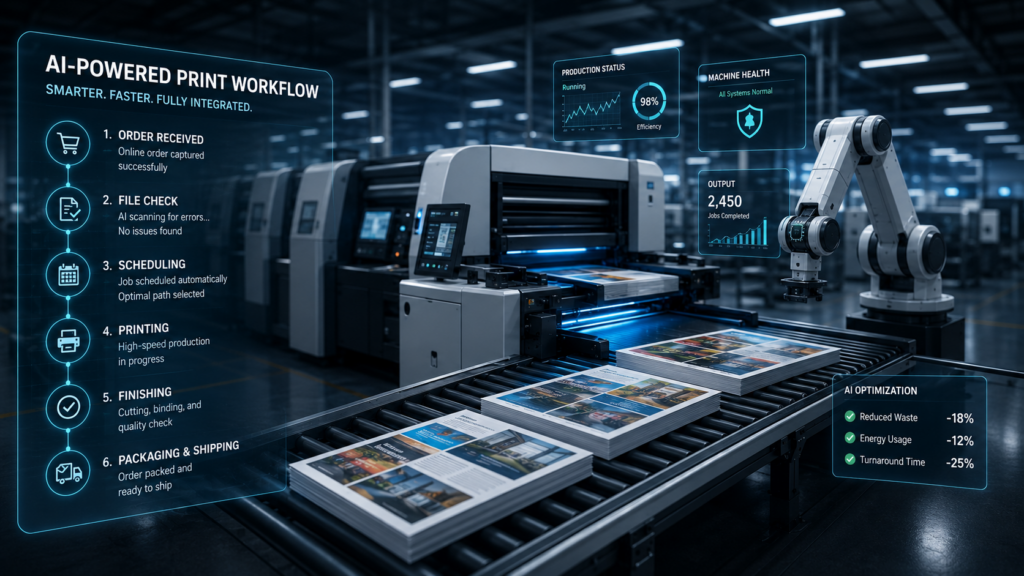
Customers place orders online on the company’s website. The provided files are then checked for flaws using a machine learning method. Jobs are automatically scheduled according to the press’s availability once the algorithm has identified the best workflow. After being automatically printed and packaged, products are dispatched straight to consumers.
AI-Generated Print Design
The technology has a somewhat negative image because many people use it to make amusing TikTok memes or fakes. But when the technology collaborates with people and clients to produce art for print, it may also be very helpful.
For instance, real estate brochures that target a luxury market and employ modern typography and style would be required. An AI system can quickly create files that are suitable for production, create layouts and apply branding in a neat and appealing manner.
Real-Time Dynamic Pricing Models
This is where AI can truly help with data-driven, dynamic pricing. The entire process can be automated by AI, which can react to changes in pertinent factors in real time. These variables include machine availability, material pricing fluctuations, work complexity, queue length and delivery urgency.
AI will eliminate the need for employees to manually modify prices in response to significant variables, such as shifts in the price of paper, for instance.
Predictive Maintenance and Operational Efficiency
The printing process is frequently hindered by malfunctioning machinery that needs to be serviced. Because of this, the setup is reactive rather than proactive. Is it impossible to fix tools before they become irreparably damaged?
One way the print industry assists with this is by combining automated tools with manual procedures. The drawback is that they are clunky and somewhat constrained. However, the procedure can be facilitated more effectively by the application of artificial intelligence.
For example, vibration and temperature analysis may be used to recommend servicing. By averting major malfunctions and stepping in when needed, this minimises downtime.
End-to-End Integrated Print Ecosystems
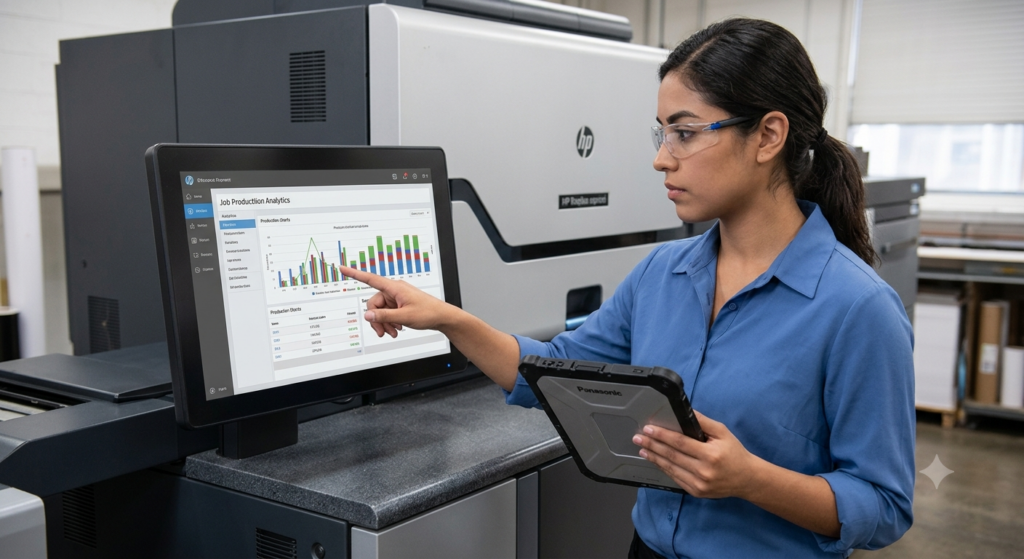
The core of artificial intelligence is the integration of print activities from start to finish. MIS and prepress tools will be seamlessly connected with logistics and delivery systems in addition to web-to-print platforms.
When the system is fully integrated, it functions like a digital brain, continuously optimising productivity without requiring human intervention – with the exception of monitoring and making decisions based on preferences and needs.
Legacy systems and other constraints have hindered the adoption of AI, although these should be viewed as transient rather than systemic. Early adopters will be in the greatest position to benefit from the growing popularity of AI-based data-driven solutions.
IMPORTANT NOTICE – Image credits: All visuals and images within the article created via generative AI tools (Chagpt – Gemini). Editorial prompt and concept by Alex Petrovic (June 2026).